In June 2025, the Bass Management Group (BMG) highlighted that a task-and-finish group was reviewing the system for authorising commercial fishing vessels to land bass in England.
This review was guided by goal 2 of the bass fisheries management plan (FMP) which is around fair access to the bass fishery, while prioritising stock sustainability.
The review
The Marine Management Organisation (MMO) led the review with help from a group of commercial and recreational fishermen, regulators and environmental groups. They met over multiple meetings and gathered views from nearly 300 stakeholders at 20 coastal events.
Current rules
The bass fishery is important for many people - from commercial fishermen to those who enjoy fishing for fun. To keep bass stocks healthy, rules were introduced after years of poor recruitment (the number of juveniles that join the adult stock in any given year) and heavy fishing. These include:
- A minimum size for bass
- Special authorisations for commercial bass fishing
- Seasonal closure for all fishers
- Limits on how many bass can be landed or kept as bycatch
Recommendations
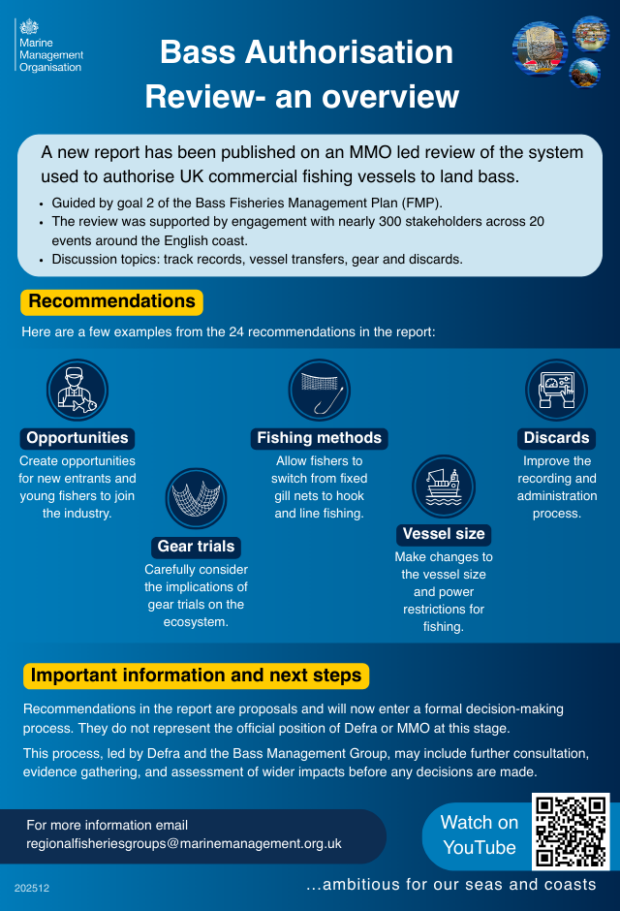
The review produced 24 recommendations to help with the long-term health of the fishery.
Key proposals include:
- Increasing the number of authorisations to land bass
- A scheme providing access for young people wishing to enter the fishery
- Allowing fishers the option to switch from fixed gillnet authorisation to hooks and lines
- Gear trials - including an inshore drift netting scientific trial
- Establishing a working group to review demersal trawls and seines
- A bycatch allowance trial for non-authorised fixed gillnet fishers
- Development of an accredited hook-to-plate bass fishery
- Adjustments to engine power and vessel size restrictions
What happens next?
It's important to be clear that these are recommendations and not final decisions. Defra and the BMG will now look at the evidence, consult further, and assess impacts before any changes are made.
Reports and helpful products
Find a report of the review on GOV.UK. An infographic and video summarising the report are below.
8 comments
Comment by Greg posted on
Hi, I have read the report but cannot see how the recommendations deliver Goal 5 for Recreational fishers. This must be an oversight as recreational fishers catch the most Bass (according to ICES) and each one caught has greater economic value than an equivalent commercially caught fish. Can you explain how this was considered and catered for in the report? Thanks.
Comment by Blog editor posted on
The bass authorisation review report summarises the findings of a multi-stakeholder group that looked at how English commercial fishing vessels are authorised to land bass. The aim was to review the current system and make recommendations that align with wider fisheries management plan (FMP) goals such as Goal 5, which focuses on maximising the benefits of bass fishing for local coastal communities.
Recreational fishing was not the focus of this review, that is managed through the Bass Management Group (BMG) and Defra. However, the report does consider how each recommendation could affect other sectors, including recreational fishing. These impacts are noted in the recommendations, benefits and risks sections throughout the report.
Comment by Daniel Bowering posted on
Can someone explain how increasing all methods of landing bass helps with the second part of the goal namely 'while prioritising stock sustainability' please.
Comment by Blog editor posted on
International Council for the Exploration of the Sea (ICES) annual advice for bass (2026) set a maximum sustainable yield of 6590 tonnes that may be harvested, a significant increase on 2025.
Whilst the bass stock has recovered significantly since the introduction of joint UK/EU management measures in 2015, the UK’s position remains one of caution and seeks to strike a balance between protecting the stock and increasing fishing opportunities for commercial and recreational fisheries. Therefore, approximately 853 tonnes of bass from this year’s advice has been reserved to allow the stock to continue to recover.
Comment by Daniel Bowering posted on
Thank you for the reply.
Does the 853 tonnes reserved for continuing recovery take into account the 190 extra bass authorisations granted for 2026?
Comment by Blog editor posted on
No new bass authorisations have been issued for 2026.
If you have further questions on the bass authorisation guidance please find contact details on: Bass industry guidance 2026 - GOV.UK
Comment by Amy posted on
As a keen young member of the commercial fishing industry I am keen to know what is happening with recommendation 3 of the bass authorisation review and how it would become available for people like myself to apply to obtain one of the newly created bass authorisations.
Comment by Blog editor posted on
Thanks for your question relating to recommendation 3 in the Bass Authorisation Review. This recommendation relates to unused bass authorisations.
Defra has asked the Bass Management Group (a group of industry and government representatives) to look at this recommendation and explore options. The proposals currently being discussed include:
1. Issuing unused authorisations.
2. Allowing fishers to switch from fixed gillnets to hooks and lines.
3. Developing a young person’s scheme.
The group aims to finish these discussions by the end of March 2026 and report back to Defra. Defra will then review the group’s advice before making any decisions.
Updates will be shared on this blog, and you can also subscribe to email alerts to make sure you don’t miss future announcements.