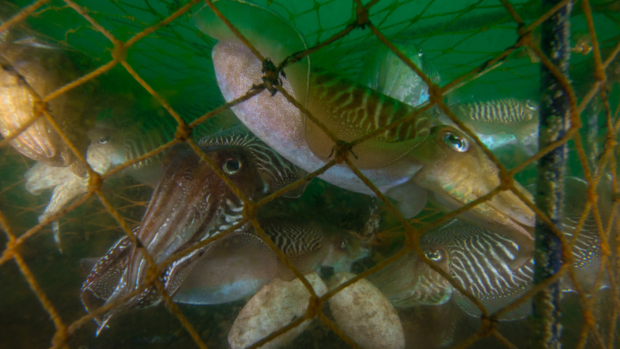
The Marine Management Organisation (MMO) is working hard to improve its knowledge and build a collaborative approach to managing the cuttlefish fishery as part of the Channel demersal non-quota species fisheries management plan (FMP).
Several major milestones were achieved in 2025 for the FMP including the publication of the first ever Cuttlefish Action Plan. Several actions from the plan have been completed including cuttlefish market sampling to explore the presence of the species.
Research at markets
Between November 2024 and April 2025, MMO visited markets in Newlyn, Brixham, and Hastings. They took samples to test the effectiveness of three new cuttlefish species ID cards and gather biological data.
Highlights include:
- Species identification success: all three species; common, elegant, and pink cuttlefish were correctly identified by MMO staff using the new ID cards.
- What we found in catches: Trawlers caught high numbers of small cuttlefish and maturing adults. Catching too many small cuttlefish could mean fewer adults the following year. Catching too many maturing adults may affect spawning and reproduction. This matters for keeping the fishery healthy long-term.
- Biometric insights: We measured the size and weight of different cuttlefish species and found strong connections between weight-to-mantle length. The mantle is the length of the body excluding the head of the cuttlefish. Elegant and pink cuttlefish are smaller and likely mature whereas small common cuttlefish are likely juveniles which suggests each species has a different lifecycle.
- Seasonal trends: Bigger cuttlefish appeared in late autumn and early winter, while the smaller ones were more common in later months. Elegant and pink cuttlefish were seen the most between December and February.
- Hastings potting season: Common cuttlefish longer than 15cm made up most of the samples. This shows that the fishing gear used was selective during the spawning season, allowing smaller cuttlefish to escape from the pots and be returned to the sea.
These findings highlight the importance for fishermen to record different species and to keep gathering and monitoring spatial and biometric data.
This data is useful for making management choices based on facts, such as determining a potential maximum sustainable yield (MSY) or proxy - MSY levels are the largest catch that can be removed from the stock while, without reducing its ability to replenish itself.
You can find the Cuttlefish Market Sampling Report 2025 report on GOV.UK.
Why correct species identification matters
Correctly identifying cuttlefish species is important for managing them sustainably and gathering credible data.
Fishermen need to make every effort to avoid using the generic landing code CTL, as this hides species-level trends that are crucial for stock assessments.
To help with this, get our cuttlefish species ID cards online, or pick up a copy from your local MMO office.
Cuttlefish Action Plan progress
A recent review shows that good progress has been made. In addition to the research and ID cards, completed actions include:
- Introduction of a Voluntary Code of Practice on cuttlefish trap handling to protect eggs and improve recruitment.
- Initial exploration of a Harvest Control Strategy by Cefas.
Ongoing work:
- Exploring gear selectivity trials with producer organisations (POs) to reduce juvenile catch.
- Catch Per Unit Effort (CPUE) analysis to assess trawling impacts. CPUE is a measure of how many fish are caught for the work you done to catch them. This could be how many hours spent fishing or how many nets used.
- Collaboration on research projects addressing evidence gaps, including spawning habitat and predator-prey dynamics.
Get involved
We’re heading out across the South and South West to speak directly with the people who know these fisheries best. These informal drop-in ‑in sessions are a chance to:
- Tell us what you think of the action plan and what could work better.
- Hear how our current actions are progressing and help shape future management ideas and research priorities.
- Look together at the latest results from the market sampling project and what they mean for the fishery.
- Discuss how the Voluntary Codes of Practice are being used in the real world — and how well they’re working.
Whether you're a skipper, crew member, producer organisation, Inshore Fisheries and Conservation Authorities (IFCA) officer, processor, or from an environmental non-governmental organisation (eNGOs), your insight is essential. The more we hear from you, the better we can ensure management measures are practical, evidence ‑based, and support both a healthy stock and a healthy industry.
📍 Where you will find us
Monday 2 March 2026
- Newlyn 10:00am to 11:30am - CFPO, 46 Fore Street TR18 5JR
- Plymouth 3:30pm to 5:00pm - The Ship, The Barbican PL1 2JZ
Tuesday 3 March 2026
- Brixham 10:00am to 11:30am - Brixham Trawler Agents Ltd, New Fish Quay, Brixham TQ5 8AW
- Lyme Regis 3:00pm to 4:30pm - Fishing College, Harbour Entrance, The Cobb DT7 3JJ
Wednesday 4 March 2026
- Weymouth 10:30am to 12:00pm – The Ship Inn Custom House Quay, DT4 8BE
- Poole 2:30pm to 4:00pm - MMO Poole, The Quay BH15 1HP
Thursday 5 March 2026
- Portsmouth 9:30am to 11:00am - Farmhouse Innlodge Hotel, Burrfields Road PO3 5HH
- Shoreham-by-Sea 2:30pm to 4:00pm - Sussex Yacht Club, 85/89 Brighton Road BN43 6RF
Friday 6 March 2026
- Eastbourne 9:00am to 10:00am - Eastbourne CIC, Fishermans Quay, Atlantic Drive BN23 5UY
- Hastings 1:00pm to 2:30pm - RNLI Lifeboat Station, The Stade, Rock-a-Nore Road TN34 3FJ
For more information contact fmp@marinemanagement.org.uk
Leave a comment